Case Study
Inside the Pursuit of Dual-Platinum Certification at 2 Harbor Life Sciences Center
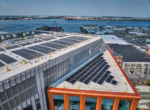
2 Harbor is a core and shell life sciences and office building located in Boston's Seaport District, developed by Beacon Capital Partners. The project recently achieved both LEED Platinum and WELL Platinum certifications — dual-platinum is a rare designation that places it among a small number of buildings in the Boston/Cambridge market and by best estimate one of less than 100 buildings worldwide.
Decision to Pursue WELL — Who, Why, and When
The decision to pursue WELL certification was market-driven and initiated by the developer, Beacon Capital Partners. While primarily an office developer, Beacon was expanding into life sciences and had established ESG objectives that aligned with the goals of WELL. They viewed the certification as a meaningful differentiator in a competitive market, having also pursued it on a comparable project in Texas. Beacon was already highly engaged with green building certifications, making WELL a natural extension of their existing commitments — though it was a first for their team under this framework.
Notably, WELL was added to the project after LEED Gold was already the target, which introduced complications. The timing of when a sustainability consultant (in this case, VvS Architects & Consultants) is brought onto a project matters significantly, as later integration can constrain the range of available strategies and require retroactive coordination across a design already in progress.
Design Integration and Programming
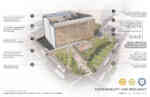
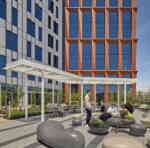
Despite the sequencing challenge, the project's program proved to be a strong foundation for WELL compliance. Features such as a fitness facility, bike storage, a mother's room, restorative spaces, and activity areas generated a significant number of WELL points at the outset — before more technically demanding credits were even considered. The building's design also worked in its favor as the generous window sizes supported daylight and views credits, which the project successfully earned, and daylighting modeling was not a required component of the certification path pursued.

Coordination and Technical Challenges
Several technical systems required careful coordination to meet WELL requirements:
- Drinking water access presented a particular challenge given the scale of the floor plate, requiring deliberate planning around proximity and distribution.
- Sink design emerged as a specific and somewhat unexpected WELL consideration, requiring attention to detail that went beyond standard specifications.
- Many of the lighting and acoustic credits were unable to be pursued, as pursuing them in a core and shell building would ultimately depend on lease requirements negotiated with future tenants — a complexity inherent to speculative development.
- Site-related credits proved more challenging than their LEED equivalents. The project was located on a brownfield site requiring remediation that exceeded national standards, requiring coordination with geotechnical engineers and hefty documentation work.
Documentation — The Largest Time Commitment
The project emphasized a broader characteristic of WELL: that for most projects most of the credits are tied to policies, documentation, and programs rather than physical design outcomes. While this takes some pressure off design teams it requires a lot of consultant time for tracking, verification, and documentation. This included verifying workplace policies related to mental health counseling, fitness programming, and employee benefits — requiring coordination with the owner's HR and benefits infrastructure in addition to the design and construction team.
Materials verification was the single most time-intensive aspect of the WELL certification process. Collecting documentation for every material and product in scope was described by the sustainability consultant as a massive effort, requiring the team to obtain comprehensive backup data from manufacturers and suppliers across the project.
Cost and Fee Considerations
WELL certification carries meaningful cost implications that teams should plan for explicitly. Certification fees alone exceeded $100,000 — a stark contrast to alternative frameworks like Fitwel, which run approximately $6,500 (a more popular health-based certification for multi-family projects). The sustainability consultant recommended that architects build a specific service fee into their scope to account for the level of coordination required: attending all relevant project meetings, facilitating communication between the owner, design team, construction manager, and other consultants, and managing the documentation process end to end. While the consultant leads the process, the architect must remain closely engaged to provide effective support throughout.
Life sciences projects are, in some respects, naturally well-suited to WELL compliance — many of the operational and environmental standards required by the certification align with what life sciences tenants already expect or require, reducing the incremental design burden compared to a conventional office building.
Post-Occupancy Verification and Recertification
WELL is not a one-time achievement. Post-occupancy verification requires physical measurement of conditions including air quality and light levels on-site, and points can be lost if the building does not perform as documented. Water quality verification was conducted both early in the process — testing against local water conditions — and again at project completion. Recertification is required every three years, with annual reporting obligations in the interim. This ongoing commitment represents a long-term operational responsibility for the building owner that should be understood and planned for at the outset.

Market Context and Differentiator Value
2 Harbor opened into a challenging leasing environment, with more available inventory than active tenants in the Seaport market at the time. The project is positioned for a corporate tenant, and the double platinum designation — while rare — has not yet translated into occupancy in a market under pressure. However, 2 Harbor is in a strong position as market conditions improve. While virtually all new buildings in Boston and Cambridge are pursuing LEED Gold at minimum, and many are adding WELL, very few have reached double platinum status. With regards to market differentiation, the sustainability consultant noted that tenants are increasingly attentive to embodied carbon reductions to support ESG goals.

Key Takeaways for Architects
- The time commitment required by WELL should not be underestimated — it is substantially greater than LEED, driven largely by the documentation and materials verification burden.
- Early integration of the sustainability consultant is critical; the later WELL is introduced, the more constrained the team's options become.
- Architects should expect to be active participants in the process rather than passive recipients of consultant guidance — understanding what is being pursued and why enables the design team to make better-informed decisions and provide more effective support throughout design, construction, and post-occupancy phases.
- Selling WELL to owners requires a strong case for market differentiation or added value as it is both expensive and requires an ongoing commitment.

01
/
00
